For the person applying, and the family helping
How to apply for a stairlift grant: the steps, the forms and the wait
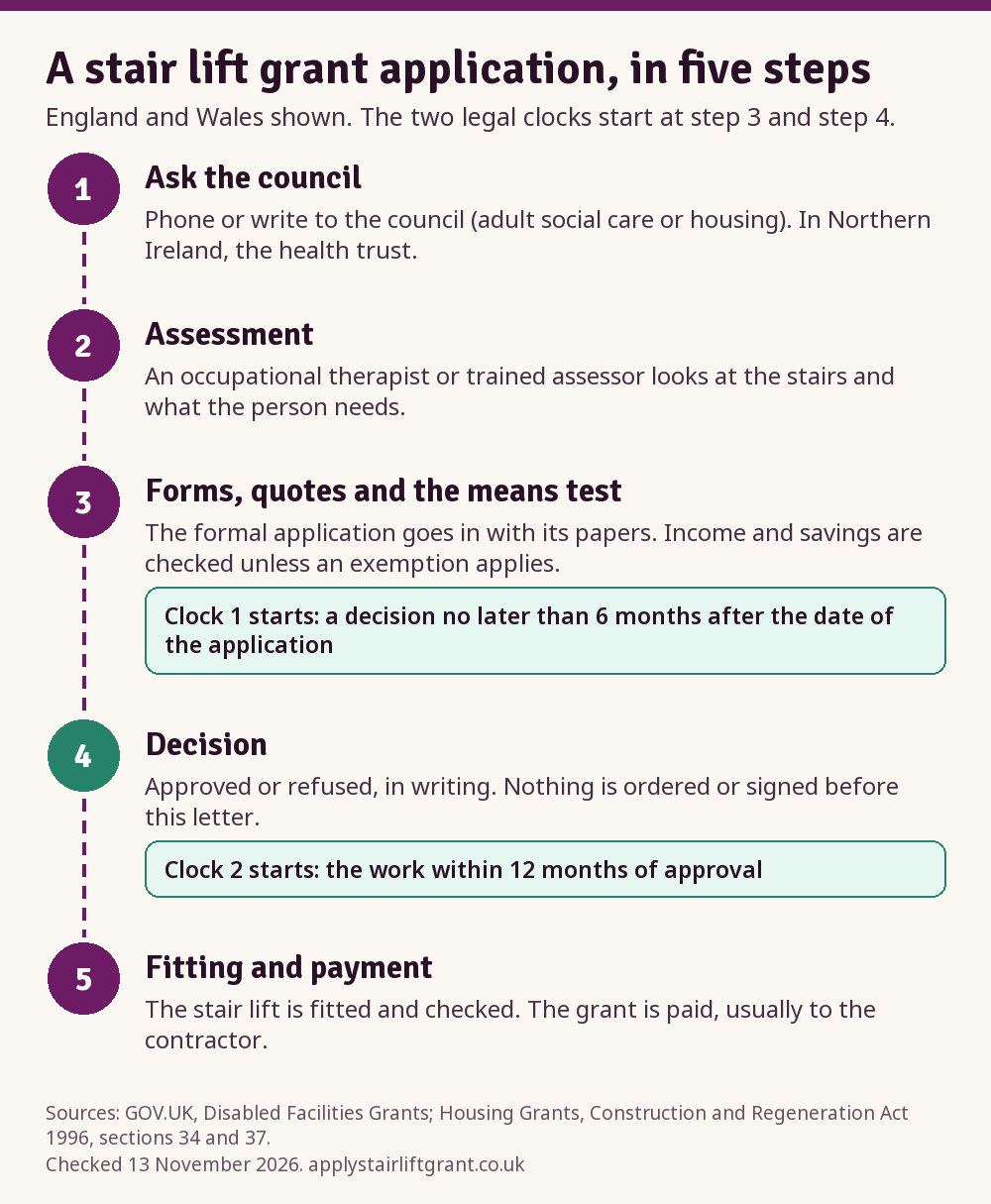
If you are working out how to apply for a stairlift grant, the order matters more than anything else: ask the council, have the assessment, send the formal application, wait for the decision, and only then let anyone fit a stair lift. Your council takes the application, not us. Below is each step, the means test and the deadlines the law sets.
- 1Ask the council
- 2Assessment
- 3Means test
- 4Decision
- 5Fitting
Ask the council, and get a quote to compare
The council's assessment comes first. A written quote alongside it shows what the stair lift would cost, so you know where you stand whatever the means test says.
Before you ask for a quote
- Only the council decidesThis form asks about a stair lift. The grant itself goes through your council, or through the health trust and the Housing Executive in Northern Ireland.
- Expect a visit and a money checkAn assessor usually looks at the stairs first. In England your income counts, and so do savings over £6,000, unless an exemption applies. Most Welsh councils skip the test for a stair lift.
- A legal clock, once you applyEngland and Wales: a decision no later than 6 months after the date of the formal application. Waiting for the assessment comes first and is not counted.
- Hold off on ordersSign nothing and book no fitting until the approval letter arrives.
Checked 13 Nov 2026 against GOV.UK's council finder, GOV.UK on applying, GOV.UK on the amount, section 34 of the 1996 Act, nidirect and the Welsh Government.
The approval letter comes first
In GOV.UK's words: You might not get any grant if you start work on your property before the council approves your application.
Paying a deposit or booking a fitting counts too.
GOV.UK, eligibility (checked 13 Nov 2026)
- 2
Assessment
An occupational therapist or trained assessor checks the stairs and what the person needs.
- 3
Means test
Income and savings are checked, unless an exemption applies.
- 4
Decision
The council approves or refuses in writing. Nothing is ordered before this.
- 5
Fitting
The stair lift is fitted, checked, and the grant is paid, usually to the fitter.
- ?
Already waiting?
Put your dates into the timeline checker to see which deadline is next.
The application in one paragraph
In England and Wales the starting point is the council that deals with Disabled Facilities Grants for your address, which GOV.UK's council finder will name. Somebody from adult social care or the housing team usually takes the first call. The council can then send an occupational therapist or a trained assessor to look at the stairs and at how the person manages them. Sources: GOV.UK: apply for a Disabled Facilities Grant (council finder) (checked 13 Nov 2026); GOV.UK: Disabled Facilities Grants, how to apply (checked 13 Nov 2026)
If the assessment supports a stair lift, the council's grants team asks for the formal application. That is the form, signed, with the evidence it lists: who owns the home, who lives there, money details for the means test, and often quotes for the work. Its date matters, because it starts the legal clock described on how long it takes.
The step-by-step version, with what differs in each nation, is on the application from start to finish.
The route in each nation
The same five steps, with different names and different front doors. Northern Ireland is the one that most often catches people out: there, the application starts with the health trust, not with a form.
England
- Find your council on GOV.UK and ask for a Disabled Facilities Grant assessment for a stair lift.
- An occupational therapist or trained assessor visits.
- Fill in the formal application; the means test usually applies.
- A decision no later than 6 months after the date of the application.
- The work within 12 months of approval; the grant is usually paid to the contractor.
Sources: GOV.UK: apply for a Disabled Facilities Grant (council finder) (checked 13 Nov 2026); GOV.UK: Disabled Facilities Grants, how to apply (checked 13 Nov 2026); GOV.UK: Disabled Facilities Grants, what you'll get (checked 13 Nov 2026); Housing Grants, Construction and Regeneration Act 1996, section 34 (decision within six months) (checked 13 Nov 2026)
Wales
- Home owners go to the local authority. Tenants ask their landlord first.
- The local authority may send an occupational therapist.
- Most councils do not means-test a stair lift.
- The same 6 months decision rule as England.
- Housing association tenants: the association applies for its own grant.
Sources: GOV.WALES: adapt your home, how to apply (checked 13 Nov 2026); GOV.WALES: written statement, removing the means test for small and medium grants (checked 13 Nov 2026); Housing Grants, Construction and Regeneration Act 1996, section 34 (decision within six months) (checked 13 Nov 2026); GOV.WALES: adapt your home if you live in social housing (checked 13 Nov 2026)
Scotland
- Contact the council's social work team for an assessment.
- An assessment is required before any financial help.
- If the council finds the adaptation essential, a grant of at least 80% of the approved cost.
- 100% for people on certain benefits.
- Private tenants need the landlord's consent before any work.
Sources: mygov.scot: how to apply for care equipment or home adaptations (checked 13 Nov 2026); gov.scot: funding adaptations to the home, a guide for homeowners (checked 13 Nov 2026); Housing (Scotland) Act 2006 (Scheme of Assistance) Regulations 2008 (checked 12 Nov 2026); gov.scot: funding adaptations to the home, a guide for private tenants (checked 13 Nov 2026)
Northern Ireland
- Start with the health trust: you may be able to refer yourself to its occupational therapy service, or ask your GP.
- Only work the occupational therapist recommends is considered.
- The Housing Executive runs the grant and works out any contribution.
- By law a decision is due no later than 6 months after the date of the application; no work before approval.
- Then the works within 12 months of approval, unless the Housing Executive allows longer.
Sources: nidirect: adapting your home (checked 13 Nov 2026); nidirect: Disabled Facilities Grants (checked 13 Nov 2026); Housing (Northern Ireland) Order 2003, article 65 (decision within 6 months of the application) (checked 13 Nov 2026); Housing (Northern Ireland) Order 2003, article 68 (works within 12 months of approval) (checked 13 Nov 2026)
The deadlines the law sets
Two clocks matter in England, Wales and Northern Ireland. Neither starts at your first phone call.
| Nation | Decision on the application | The work |
|---|---|---|
| England | No later than 6 months after the date of the application | Within 12 months of approval, which the council can extend |
| Wales | The same Act: no later than 6 months after the date of the application | Within 12 months of approval |
| Scotland | No national deadline found in the official pages read | Agreed with the council |
| Northern Ireland | A 2003 Order: no later than 6 months after the date of the application, and nothing starts before approval | Within 12 months of approval, which the Housing Executive can extend |
Sources: Housing Grants, Construction and Regeneration Act 1996, section 34 (decision within six months) (checked 13 Nov 2026); Housing Grants, Construction and Regeneration Act 1996, section 37 (work within twelve months) (checked 13 Nov 2026); gov.scot: funding adaptations to the home, a guide for homeowners (checked 13 Nov 2026); Housing (Northern Ireland) Order 2003, article 65 (decision within 6 months of the application) (checked 13 Nov 2026); Housing (Northern Ireland) Order 2003, article 68 (works within 12 months of approval) (checked 13 Nov 2026); nidirect: Disabled Facilities Grants (checked 13 Nov 2026)
England's guidance for councils adds target times for each stage, counted from the first enquiry, and says approval itself should take no longer than 5 working days in an urgent case or 20 working days in a non-urgent one. They are targets, not law. Source: GOV.UK: Disabled Facilities Grant delivery, guidance for local authorities in England (checked 13 Nov 2026) The timeline checker lays your own dates against both.
The means test, briefly
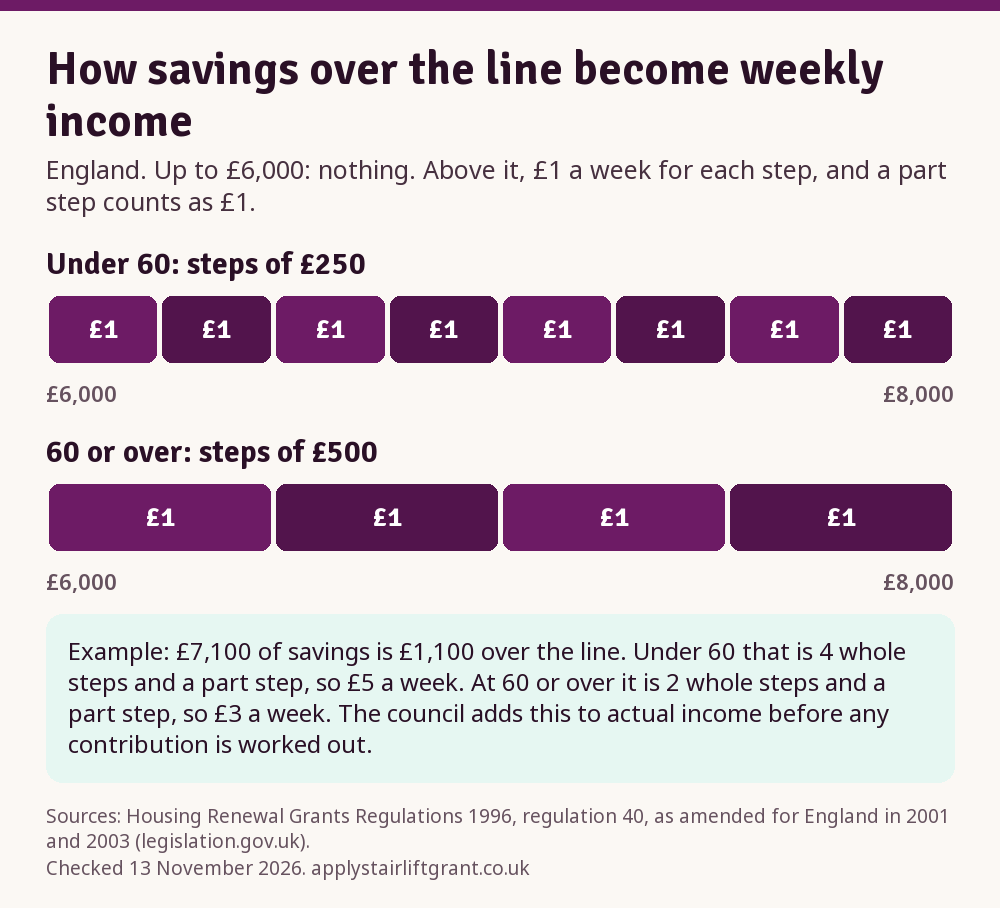
In England the amount usually depends on the income of the disabled person and their partner, and on savings over £6,000. Savings above that line are turned into an assumed weekly income: £1 for every £250, or for every £500 once the disabled person is 60, with any part step also counted as £1. Sources: GOV.UK: Disabled Facilities Grants, what you'll get (checked 13 Nov 2026); Housing Renewal Grants Regulations 1996, regulation 40 (tariff income from capital), as made (checked 13 Nov 2026)
Some people skip the test altogether. A disabled child under 18 is assessed without the parents' money, a landlord's application is not tested, and a disabled person who gets Universal Credit, Housing Benefit, Income Support, income-based Jobseeker's Allowance, income-related Employment and Support Allowance or the guarantee credit part of Pension Credit is treated as having nothing to contribute. Personal Independence Payment, Disability Living Allowance and Attendance Allowance are not counted as income. Sources: GOV.UK: Disabled Facilities Grant delivery, guidance for local authorities in England (checked 13 Nov 2026); Personal Independence Payment (Supplementary Provisions and Consequential Amendments) Regulations 2013, Schedule, paragraph 18 (checked 12 Nov 2026)
Wales is different: most councils there have not tested a stair lift grant since April 2021. In Scotland the basic grant of at least 80% is not income-tested, and it rises to 100% for people on Universal Credit, Income Support, income-based Jobseeker's Allowance, income-related Employment and Support Allowance or the guarantee credit part of Pension Credit. Sources: GOV.WALES: written statement, removing the means test for small and medium grants (checked 13 Nov 2026); Housing (Scotland) Act 2006 (Scheme of Assistance) Regulations 2008 (checked 12 Nov 2026); Scottish regulations of 2013 adding Universal Credit (checked 12 Nov 2026)
Try the means test estimator for the one figure it can honestly give, or read how savings are treated.
Three tools for the application
Each one runs on this page in your browser. None of them sends your answers anywhere.
- Estimator
Means test calculator
Tells you whether a test is likely where you live, and for England the weekly income your savings add. Indicative, and never a bill.
- Dates
Grant timeline
Enter the date of your application or approval and see the legal deadline, plus England's target times.
- Printable
Evidence checklist
The papers a council form usually asks for, sorted by whether you own, rent or let the home.
While the council decides
Waiting is the hardest part. Some things are safe to do now; a few can cost you the grant.
The rule behind this is GOV.UK's: start before approval and you may get nothing. A stair lift is no exception, so ordering one, or paying a deposit on one, counts as starting. GOV.UK, eligibility (read 13 Nov 2026).
More on waiting, including what to do if you have already bought one
Safe now
- Ask for written quotes, without signing.
- Gather the papers on the checklist.
- Keep a note of every call and letter.
- Ask the council for an early look at the means test.
Wait for approval
- Signing an order or contract.
- Paying a deposit.
- Booking a fitting date.
- Starting any building work.
When the answer is no, or slow
Ask for the reasons in writing first. A refusal, a long delay or an award lower than you expected all go to the council before anyone else: GOV.UK describes appealing to the council and then complaining to the ombudsman. Source: GOV.UK: Disabled Facilities Grants, how to apply (checked 13 Nov 2026)
- England: the council's complaints procedure, then the Local Government and Social Care Ombudsman. It is free, and you can go to it if the council has not answered your complaint in a reasonable time, which it puts at up to 16 weeks in most cases. Source: Local Government and Social Care Ombudsman: how to complain (checked 13 Nov 2026)
- Wales: the council, then the Public Services Ombudsman for Wales, which can look at delays, including in arranging the assessment. Source: Public Services Ombudsman for Wales: Disabled Facilities Grants fact sheet (checked 13 Nov 2026)
- Scotland: the council's complaints procedure, then the Scottish Public Services Ombudsman. Source: mygov.scot: complain about a public service (checked 13 Nov 2026)
- Northern Ireland: the body itself, then the Northern Ireland Public Services Ombudsman. Source: nidirect: making a complaint against government or public bodies (checked 13 Nov 2026)
The full route, with time limits, is on appeals and complaints.
Every step has its own page
Pick up wherever you are in the process.
The application, start to finish
Every step in order, with what changes in each nation and where quotes fit.
The application form
Why there is no national form, and what a council form asks for.
Applying online
What you can do online, and the parts that still happen at home.
The assessment visit
What is checked on the stairs, how to prepare, private assessments.
How the means test works
Whose money counts, what is ignored, and who is exempt.
Means test thresholds
Why there is no single cut-off, and the one line that is fixed.
Savings and the test
What happens to savings above the line, with worked examples.
Benefits and PIP
Benefits that mean no contribution, and income that is ignored.
How long it takes
The legal clocks, when they start, and the target times.
While you wait
What is safe to do, and what can cost you the grant.
Appeals and complaints
A refusal, a delay or a low award: who to go to, in order.
Help with applying
Agencies and charities that can fill the forms in with you.
Want help with the forms themselves? Who can help you apply. Unsure about a word on a letter? See words used in applications. How we check each rule is on sources and checks, and who we are is on about this site.
Questions about applying
Start with GOV.UK's finder, which takes your postcode and sends you to the council that handles Disabled Facilities Grants where you live, in England or Wales. That council decides how it takes the first contact, and its own website will say whether you can do it online. The visit, the signed application and the papers still follow, so plan for some of it to happen on paper.
England's savings rule is a sliding scale rather than a cut-off. Savings up to £6,000 are left out. Above that, each £250 (or £500 if the disabled person is 60 or over), and any part of one, is treated as £1 a week of extra income. The more income the test finds, the bigger the contribution, and the guidance for councils accepts that some people find the grant comes to little or nothing.
In England and Wales the council must decide as soon as reasonably practicable and no later than 6 months after the date of the formal application. The wait for the assessment usually comes before that date, so the whole process often runs longer. England's guidance also sets target times for councils, counted from the first enquiry.
In England the application can come from the owner, a tenant or a landlord. A tenant normally needs the landlord to sign a certificate, and the disabled person must intend to live in the home for the grant period, usually five years, or as long as their health allows.
Not before the approval letter. GOV.UK warns that starting before approval can lose the whole grant, and that includes ordering or paying a deposit. Ask for the quote in writing, keep it, and give a copy to the council if they ask for one.
Get a stair lift quote while the council decides
A written quote helps you see what the work costs while the grant is being decided, and you can show it to the council if they ask. Your message goes to SEO Dons Ltd, the publisher of this website, and the reply comes by email.
What happens next
- SEO Dons Ltd reads your message. We publish this site: we are not your council, not the NHS and not a stair lift fitter.
- We reply by email about a quote for the stairs you describe. Keep it on file, and sign nothing until the council's approval letter arrives.
- Your grant application stays with the council, or with the health trust and the Housing Executive in Northern Ireland. This form does not start one.
You don't have to buy anything.
Before you ask for a quote
- Only the council decidesThis form asks about a stair lift. The grant itself goes through your council, or through the health trust and the Housing Executive in Northern Ireland.
- Expect a visit and a money checkAn assessor usually looks at the stairs first. In England your income counts, and so do savings over £6,000, unless an exemption applies. Most Welsh councils skip the test for a stair lift.
- A legal clock, once you applyEngland and Wales: a decision no later than 6 months after the date of the formal application. Waiting for the assessment comes first and is not counted.
- Hold off on ordersSign nothing and book no fitting until the approval letter arrives.
Checked 13 Nov 2026 against GOV.UK's council finder, GOV.UK on applying, GOV.UK on the amount, section 34 of the 1996 Act, nidirect and the Welsh Government.
The approval letter comes first
In GOV.UK's words: You might not get any grant if you start work on your property before the council approves your application.
Paying a deposit or booking a fitting counts too.
GOV.UK, eligibility (checked 13 Nov 2026)