Before you start: who can apply
The person who needs the stair lift does not have to be the one who signs. In England a valid application can come from someone with an owner's interest (an owner-occupier or a landlord) or from a tenant. Nobody under 18 can receive the grant themselves, so an adult applies on behalf of a disabled child. Source: GOV.UK: Disabled Facilities Grant delivery, guidance for local authorities in England (checked 13 Nov 2026)
Whoever applies signs a certificate saying the disabled person intends to live in the home as their only or main residence for the grant condition period, usually five years, or for as long as their health and circumstances allow. A tenant's application normally needs the landlord's signature on an owner's certificate too, though the council can drop that requirement if it thinks the landlord is being unreasonable. Sources: GOV.UK: Disabled Facilities Grants, eligibility (checked 13 Nov 2026); GOV.UK: Disabled Facilities Grant delivery, guidance for local authorities in England (checked 13 Nov 2026)
The five steps
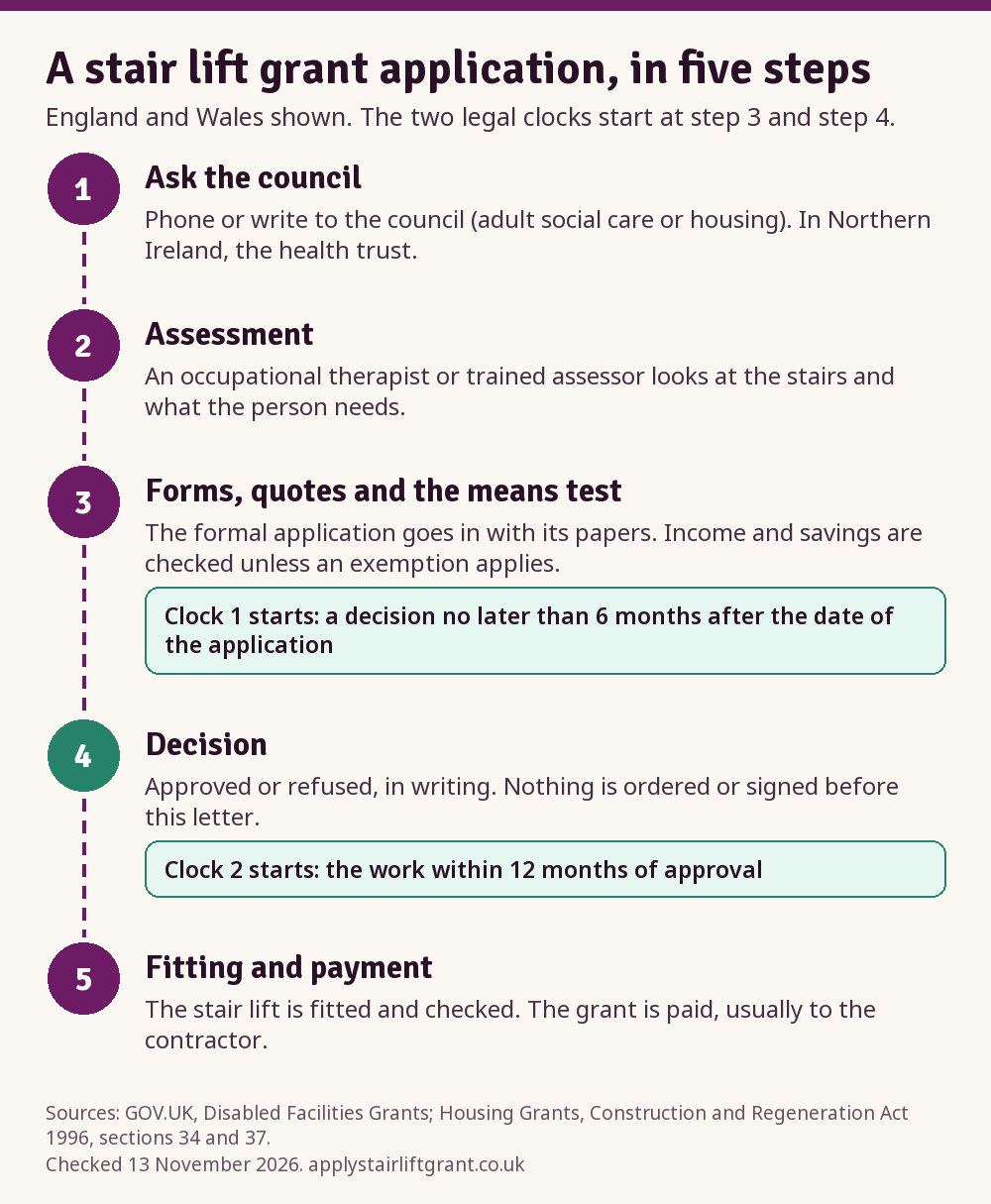
Contact the council
GOV.UK's finder takes your postcode and gives you the council that handles Disabled Facilities Grants for your address. Tell them you want an assessment for a stair lift and that you would like to apply for the grant. Source: GOV.UK: apply for a Disabled Facilities Grant (council finder) (checked 13 Nov 2026)
Mention anything that makes the case urgent. England's guidance asks councils to treat these as urgent: someone coming out of hospital and at risk, living alone and at risk, with severe cognitive difficulties and at risk, living with a carer who is elderly or disabled, living without heating or hot water and at risk, or with a limited life expectancy. Source: GOV.UK: Disabled Facilities Grant delivery, guidance for local authorities in England (checked 13 Nov 2026)
The assessment
The council may send an occupational therapist or a trained assessor. Two tests decide whether a grant can follow: the work must be necessary and appropriate for the disabled person's needs, and reasonable and practicable given the age and condition of the home. The second test is why a narrow or awkward staircase sometimes leads to a different answer than a stair lift. Sources: GOV.UK: Disabled Facilities Grants, how to apply (checked 13 Nov 2026); GOV.UK: Disabled Facilities Grants, eligibility (checked 13 Nov 2026); Public Services Ombudsman for Wales: Disabled Facilities Grants fact sheet (checked 13 Nov 2026)
Simpler cases may go to a trusted assessor so that occupational therapists can concentrate on complex ones. What happens on the visit is on the assessment page. Source: GOV.UK: Disabled Facilities Grant delivery, guidance for local authorities in England (checked 13 Nov 2026)
The formal application and the means test
Once the work is agreed, the council's grants team asks for the formal application. It is the council's own form, and there is no single national version: the application form page sets out what one asks. Evidence of income and savings goes in with the form so that approval is not held up waiting for it. Source: GOV.UK: Disabled Facilities Grant delivery, guidance for local authorities in England (checked 13 Nov 2026)
In England the grant is usually means-tested, and the final contribution is worked out just before the formal application. The means test estimator shows the one part of that sum you can check for yourself. Sources: GOV.UK: Disabled Facilities Grants, what you'll get (checked 13 Nov 2026); GOV.UK: Disabled Facilities Grant delivery, guidance for local authorities in England (checked 13 Nov 2026)
The date the council records for your application is the one that matters. It starts the clock on the decision.
The decision
The council must say whether it approves or refuses as soon as reasonably practicable and no later than 6 months after the date of the application. Where the council or a home improvement agency helped prepare the application, the guidance expects approval within 4 weeks. Refusing to accept applications because money is short is unlawful. More detail is on how long it takes. Sources: Housing Grants, Construction and Regeneration Act 1996, section 34 (decision within six months) (checked 13 Nov 2026); GOV.UK: Disabled Facilities Grant delivery, guidance for local authorities in England (checked 13 Nov 2026)
Fitting and payment
Only now is the stair lift ordered. The grant is normally conditional on the work being done within 12 months of approval, and the council can extend that. It pays in instalments as work goes on, or in full at the end, usually straight to the contractor. Sources: Housing Grants, Construction and Regeneration Act 1996, section 37 (work within twelve months) (checked 13 Nov 2026); GOV.UK: Disabled Facilities Grants, how to apply (checked 13 Nov 2026)
Read the approval letter's conditions before the fitting date. A council may make it a condition that specialist equipment such as a stair lift is recovered when it is no longer needed. Source: GOV.UK: Disabled Facilities Grant delivery, guidance for local authorities in England (checked 13 Nov 2026)
Quotes, contractors and fees inside the grant
The checklist England's guidance gives councils for their forms includes a detailed breakdown of the work with competitive estimates from at least 2 builders. For a stair lift that usually means two written quotes for the same staircase. Ask each company to quote for what the assessor recommended, not a model of its own choosing. Source: GOV.UK: Disabled Facilities Grant delivery, guidance for local authorities in England (checked 13 Nov 2026)
Some costs around the work can be part of the grant: help with completing forms, surveys, plans and specifications, and the charges of a private occupational therapist in relation to the work. Councils cannot charge you for processing the application. Source: GOV.UK: Disabled Facilities Grant delivery, guidance for local authorities in England (checked 13 Nov 2026)
Stair lifts need servicing. The guidance says the cost of an extended guarantee or service contract paid upfront when the lift is commissioned can be included in the grant, while later repairs are a separate matter. Ask the council, before approval, whether your quote should include one. Source: GOV.UK: Disabled Facilities Grant delivery, guidance for local authorities in England (checked 13 Nov 2026)
What changes in Wales, Scotland and Northern Ireland
| Nation | Where to start | What is different |
|---|---|---|
| Wales | Owners: the local authority. Tenants: the landlord first. | Most councils have not means-tested a stair lift since April 2021. Housing association tenants go through the association's own grant. |
| Scotland | The council's social work team, for an assessment. | No Disabled Facilities Grant. A grant of at least 80% where the council finds the adaptation essential, 100% on certain benefits. |
| Northern Ireland | The health trust's occupational therapy service, or your GP. | The Housing Executive runs the grant, on the occupational therapist's recommendation, and by law must decide no later than 6 months after the date of the application. No work before approval; then the works within 12 months, unless it allows longer. |
Sources: GOV.WALES: adapt your home, how to apply (checked 13 Nov 2026); GOV.WALES: written statement, removing the means test for small and medium grants (checked 13 Nov 2026); GOV.WALES: adapt your home if you live in social housing (checked 13 Nov 2026); gov.scot: funding adaptations to the home, a guide for homeowners (checked 13 Nov 2026); Housing (Scotland) Act 2006 (Scheme of Assistance) Regulations 2008 (checked 12 Nov 2026); nidirect: adapting your home (checked 13 Nov 2026); nidirect: Disabled Facilities Grants (checked 13 Nov 2026); Housing (Northern Ireland) Order 2003, article 65 (decision within 6 months of the application) (checked 13 Nov 2026); Housing (Northern Ireland) Order 2003, article 68 (works within 12 months of approval) (checked 13 Nov 2026)
Wherever you live, the order holds. If something goes wrong, appeals and complaints explains who to go to.