The rule, in plain words
Regulation 40 of the Housing Renewal Grants Regulations 1996 deals with savings, which it calls capital. As amended for England, it says that where the relevant person's capital is more than £6,000, it is treated as producing a weekly "tariff income" of £1 for each complete £250 over £6,000 for someone under 60, and £1 for each complete £500 for someone aged 60 or over. Sources: Housing Renewal Grants Regulations 1996, regulation 40 (tariff income from capital), as made (checked 13 Nov 2026); Housing Renewal Grants (Amendment) (England) Regulations 2001, regulation 11 (the £6,000 line) (checked 13 Nov 2026); Housing Renewal Grants (Amendment) (England) Regulations 2003, regulation 15 (£250 and £500) (checked 13 Nov 2026)
A second paragraph of the same regulation catches the remainder: where part of the excess is not a complete step, that part is also treated as £1. So the count always rounds up. Source: Housing Renewal Grants Regulations 1996, regulation 40 (tariff income from capital), as made (checked 13 Nov 2026)
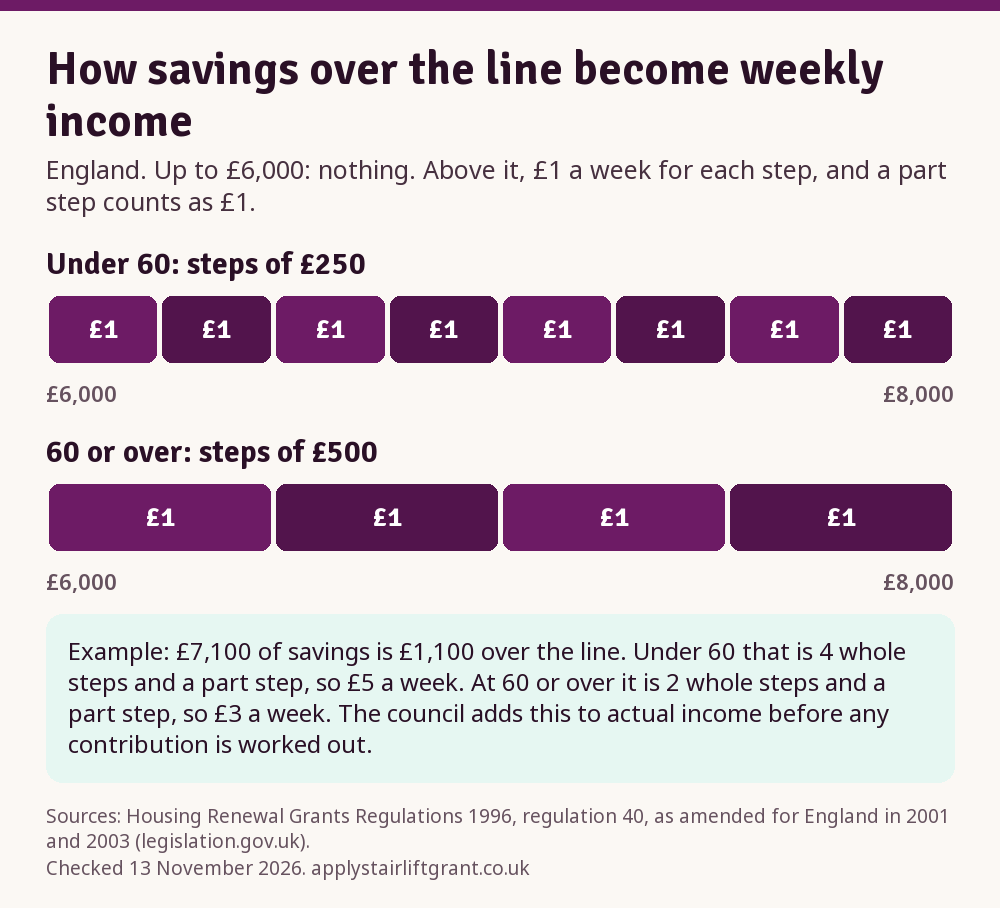
The weekly figure is not a charge. It is added to the household's actual income, and only income above the household's allowance becomes a contribution. That is why savings well over the line can still leave a grant, and why a small excess is unlikely to change much. The means test page covers the rest of the sum.
Four examples
These people are invented to show the arithmetic. Each figure comes from the rule above, the same one the estimator uses. None of them shows what anyone would actually pay.
| Example | Over the line | Step size | Weekly income counted |
|---|---|---|---|
| A widow aged 74 with £6,400 in the bank | £400 | £500 | £1 a week |
| A man aged 52 with £8,000 in savings accounts | £2,000 | £250 | £8 a week |
| A couple, the disabled partner aged 67, with £10,500 between them | £4,500 | £500 | £9 a week |
| A woman aged 45 with £20,000 in savings | £14,000 | £250 | £56 a week |
Take the first example. £400 over the line is less than one £500 step, so on the first paragraph of the rule alone it would add nothing; the second paragraph turns that part step into £1. The last example shows why large savings matter more for younger applicants: £14,000 over the line in £250 steps is 56 steps, so £56 a week.
What counts as savings
The regulations count the capital of the relevant person: the disabled person and, where they have one, their partner. If an adult son or daughter applies because they own the home, it is still the disabled person's savings that are assessed. The regulation also brings into capital any income the regulations treat as capital. Sources: Housing Renewal Grants Regulations 1996, regulation 40 (tariff income from capital), as made (checked 13 Nov 2026); GOV.UK: Disabled Facilities Grant delivery, guidance for local authorities in England (checked 13 Nov 2026)
The detailed list of what is counted and left out is in the regulations, and this site has not checked every item, so it does not say how property, pensions savings or compensation are treated. Give the council the full picture and ask it to show you what it counted.
Age matters because of the step size. The rule uses the relevant person's age. For a couple where one is under 60 and one over, ask the council which step it applied.
If you have applied before
Needs change, and there is no restriction on applying again for the same home. England's guidance says a contribution you paid on an earlier grant is set against a new one if the new application comes within 5 years for tenants or 10 years for owners, provided you went ahead with the earlier work. Its example: £7,000 paid before and a new assessed contribution of £8,000 leaves £1,000 to pay. Source: GOV.UK: Disabled Facilities Grant delivery, guidance for local authorities in England (checked 13 Nov 2026)
Outside England
The savings rule above is England's. Most Welsh councils have not means-tested a stair lift grant since April 2021. Scotland's grant of at least 80% for an essential adaptation does not depend on income or savings. In Northern Ireland the Housing Executive makes its own calculation. Sources: GOV.WALES: written statement, removing the means test for small and medium grants (checked 13 Nov 2026); gov.scot: funding adaptations to the home, a guide for homeowners (checked 13 Nov 2026); nidirect: Disabled Facilities Grants (checked 13 Nov 2026)