Why there is no single form
In England the guidance to councils is plain about it: application forms should be available on request, written in plain English and simple to understand, but it is for each council to decide its own application process in line with its local policy. So the form for a stair lift in one borough can look nothing like the one next door. Source: GOV.UK: Disabled Facilities Grant delivery, guidance for local authorities in England (checked 13 Nov 2026)
GOV.UK's finder is the reliable way in. Give it your postcode and it names the council responsible for Disabled Facilities Grants at your address in England or Wales. Source: GOV.UK: apply for a Disabled Facilities Grant (council finder) (checked 13 Nov 2026)
Some councils start with a shorter enquiry. In Wales the Public Services Ombudsman notes that a council may ask you to complete a pre-application enquiries form before the formal application. Treat that as a first step, not the application itself. Source: Public Services Ombudsman for Wales: Disabled Facilities Grants fact sheet (checked 13 Nov 2026)
What a council form usually asks for
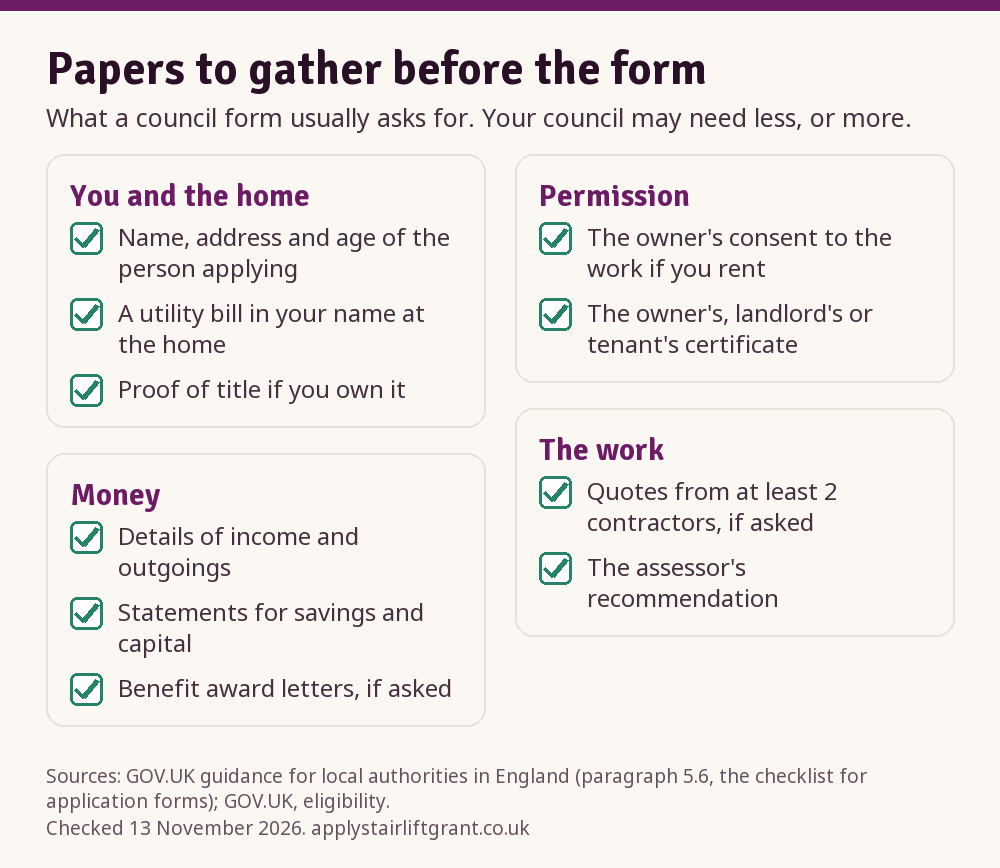
The guidance gives councils a checklist for designing their forms. Your council's form may ask for less, especially for a small job, because the guidance also says the information requested should be in proportion to the extent and cost of the work. Grouped for a reader, the checklist covers: Source: GOV.UK: Disabled Facilities Grant delivery, guidance for local authorities in England (checked 13 Nov 2026)
About you and the home
- The name, address and age of the person applying
- The name and address of the owner
- Whether you own the home, rent it or are the landlord
Money
- Enough about income and outgoings for the council to work out any contribution
The work
- A summary of the work, and a detailed breakdown
- Competitive estimates from at least 2 contractors
- Any agent helping you, and any fees for services
Certificates and proof
- An owner's, landlord's or tenant's certificate
- The owner's consent to the work
- Proof of title, and a utility bill in your name at the address
Declarations
- That the information will be checked and may be shared to prevent fraud
- That false or withheld information could lead to prosecution
The money section feeds the means test. Where a test applies, the guidance says evidence of income and savings should be collected with the form, so gather it before you sit down to fill anything in. If the disabled person gets a qualifying benefit, councils can check it through the Department for Work and Pensions' own system instead of asking you. Source: GOV.UK: Disabled Facilities Grant delivery, guidance for local authorities in England (checked 13 Nov 2026)
The work section is where quotes go. For a stair lift, that usually means a written quote for the staircase the assessor looked at, and often a second one. How the figures in those quotes become a grant is covered on the application from start to finish.
The certificates, in plain words
Three certificates confuse people more than anything else on the form.
- Owner's certificate. Signed by an owner-occupier, or by a landlord. It confirms they have, or will get, an owner's interest, and that the disabled person intends to live there as their only or main home for the grant condition period, usually five years, or as long as their health allows. Source: GOV.UK: Disabled Facilities Grant delivery, guidance for local authorities in England (checked 13 Nov 2026)
- Tenant's certificate. Signed by a tenant applying in their own right. It confirms the same intention about living there. Source: GOV.UK: Disabled Facilities Grant delivery, guidance for local authorities in England (checked 13 Nov 2026)
- The landlord's signature on a tenant's application. A tenant's application should normally come with an owner's certificate signed by the landlord. The council can waive that where it thinks the landlord is unreasonably refusing. Source: GOV.UK: Disabled Facilities Grant delivery, guidance for local authorities in England (checked 13 Nov 2026)
Two declarations close most forms: that the information will be checked and may be shared to prevent fraud, and that giving false information could lead to prosecution. Read them before you sign.
The application date matters
The guidance's checklist includes a valid application date, and for good reason. The council must decide no later than 6 months after the date of the application, so the day it records a complete application is the day the legal clock starts. Keep a copy of everything you send, and a note of the day you sent it. Sources: GOV.UK: Disabled Facilities Grant delivery, guidance for local authorities in England (checked 13 Nov 2026); Housing Grants, Construction and Regeneration Act 1996, section 34 (decision within six months) (checked 13 Nov 2026)
A form sent without its papers can sit unanswered while the council asks for more. The timescales page explains why the gap before the formal application is often the longest part.
Outside England
Wales uses the same grant and the same Act: owners apply to the local authority, and tenants ask their landlord first. Source: GOV.WALES: adapt your home, how to apply (checked 13 Nov 2026) Scotland has no Disabled Facilities Grant: you need an assessment before you can apply for financial help, and the council's social work team arranges it. Northern Ireland has no form to start with at all: only work the health trust's occupational therapist recommends can be considered, and the Housing Executive deals with the grant after that. Sources: gov.scot: funding adaptations to the home, a guide for homeowners (checked 13 Nov 2026); mygov.scot: how to apply for care equipment or home adaptations (checked 13 Nov 2026); nidirect: Disabled Facilities Grants (checked 13 Nov 2026)
Wherever you are, two numbers help you plan: use the means test estimator to see what your savings add in England's test, and keep the approval warning in mind. GOV.UK says that starting work before approval can mean no grant at all. Source: GOV.UK: Disabled Facilities Grants, eligibility (checked 13 Nov 2026)