The two clocks in law
The decision. Section 34 of the Housing Grants, Construction and Regeneration Act 1996 requires the council to tell you whether your application is approved or refused as soon as reasonably practicable and no later than 6 months after the date of the application. The guidance explains that the full six months exists for applications put together independently of the council; where the council or a home improvement agency helped prepare yours, approval would not be expected to take longer than 4 weeks. Sources: Housing Grants, Construction and Regeneration Act 1996, section 34 (decision within six months) (checked 13 Nov 2026); GOV.UK: Disabled Facilities Grant delivery, guidance for local authorities in England (checked 13 Nov 2026)
The work. Once approved, the grant is normally conditional on the work being carried out within 12 months of approval, and the council can agree to extend that period. Sources: Housing Grants, Construction and Regeneration Act 1996, section 37 (work within twelve months) (checked 13 Nov 2026); GOV.UK: Disabled Facilities Grants, how to apply (checked 13 Nov 2026)
Neither clock starts at your first call. Between the first contact and the formal application sit the assessment, the agreement about what work is needed, the quotes and the means test. That stretch is where most of the waiting happens, and it is why the application form and its date matter so much.
England's target times, stage by stage
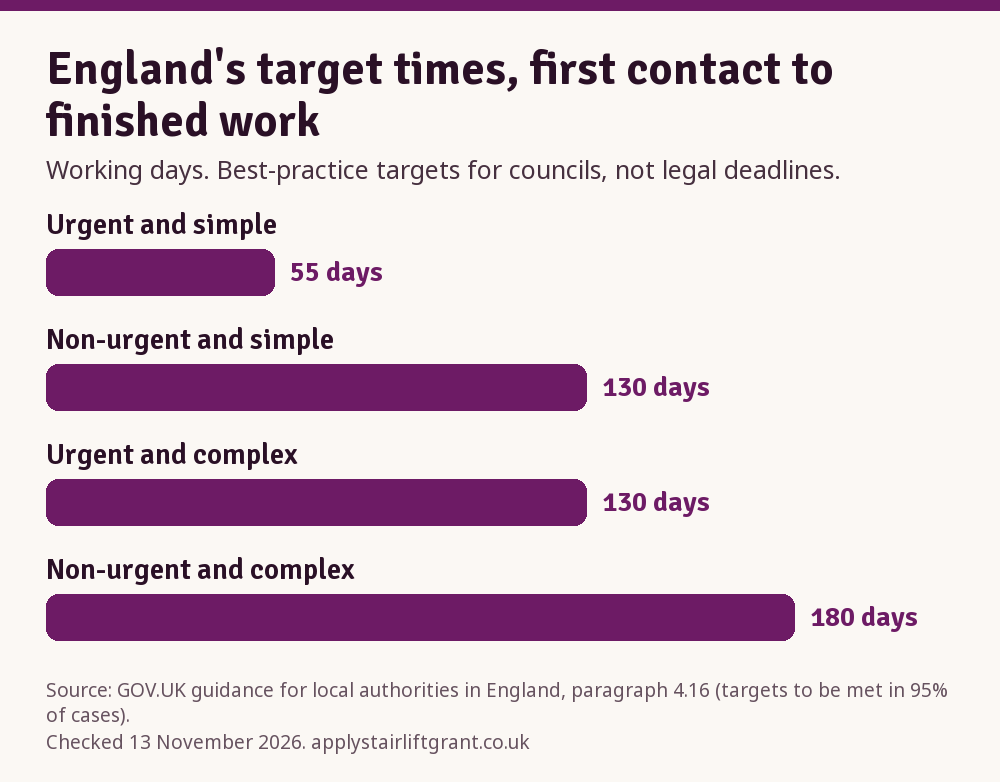
England's guidance breaks the process into stages and sets best-practice targets in working days, which it says should be met in 95% of cases. The count starts from the date of the first enquiry. They are targets for councils, not legal rights, but they are a fair yardstick when you ask where your case has got to. Source: GOV.UK: Disabled Facilities Grant delivery, guidance for local authorities in England (checked 13 Nov 2026)
| Type of case | Stage 1 | Stage 2 | Stage 3 | Stage 4 | Total |
|---|---|---|---|---|---|
| Urgent and simple | 5 | 25 | 5 | 20 | 55 |
| Non-urgent and simple | 20 | 50 | 20 | 40 | 130 |
| Urgent and complex | 20 | 45 | 5 | 60 | 130 |
| Non-urgent and complex | 35 | 55 | 20 | 80 | 180 |
Stage 1: first contact to the assessment and the list of works. Stage 2: the list of works to the formal application. Stage 3: the formal application to approval. Stage 4: approval to the finished work. Source: GOV.UK: Disabled Facilities Grant delivery, guidance for local authorities in England (checked 13 Nov 2026)
Whether a case is urgent or simple is decided early, by triage. The guidance recommends treating a case as urgent when someone is coming out of hospital and at risk, living alone and at risk, has severe cognitive difficulties and is at risk, lives with an elderly or disabled carer, is without heating or hot water and at risk, or has a limited life expectancy. If any of those apply, say so at the first contact. Source: GOV.UK: Disabled Facilities Grant delivery, guidance for local authorities in England (checked 13 Nov 2026)
For the approval step on its own, the guidance says most approvals are a straightforward check of details already gathered and should take no longer than 5 working days for an urgent case or 20 working days for a non-urgent one. Source: GOV.UK: Disabled Facilities Grant delivery, guidance for local authorities in England (checked 13 Nov 2026)
What can speed it up, and what can slow it down
- Urgent works can go first. The guidance says urgent works should be approved in advance of the rest where waiting could cause harm, and uses a lift as its example: approved while bathroom plans are still being prepared. Source: GOV.UK: Disabled Facilities Grant delivery, guidance for local authorities in England (checked 13 Nov 2026)
- Evidence with the form. Approval should not be held up chasing income and savings evidence, so the guidance says it should come in with the form. A complete application is a faster one. See the evidence checklist. Source: GOV.UK: Disabled Facilities Grant delivery, guidance for local authorities in England (checked 13 Nov 2026)
- Payment can be deferred, rarely. A council may approve but say the grant will not be paid before a set date, up to 12 months after the date of the application. The guidance limits this to exceptional pressure on budgets and says it should not be used where needs are urgent. Source: GOV.UK: Disabled Facilities Grant delivery, guidance for local authorities in England (checked 13 Nov 2026)
- Lack of money is not a reason to refuse. Refusing to accept applications because of a lack of resources is unlawful. Source: GOV.UK: Disabled Facilities Grant delivery, guidance for local authorities in England (checked 13 Nov 2026)
In England the means test runs at the same time as the paperwork; the means test page explains when the final figure is worked out, and the calculator shows the savings part of it. The full order of events is on how to get a Disabled Facilities Grant.
Wales, Scotland and Northern Ireland
- Wales: the same Act, so the same six-month rule on the decision. The Public Services Ombudsman for Wales can look at unreasonable delays before and after the application, including in arranging the occupational therapist's assessment. Sources: Housing Grants, Construction and Regeneration Act 1996, section 34 (decision within six months) (checked 13 Nov 2026); Public Services Ombudsman for Wales: Disabled Facilities Grants fact sheet (checked 13 Nov 2026)
- Scotland: no national deadline turned up in the official pages read for this site. The government's guide for home owners warns that a case assessed as low priority may wait some time and that limited budgets can delay a grant. Ask your council for its own timescales in writing. Source: gov.scot: funding adaptations to the home, a guide for homeowners (checked 13 Nov 2026)
- Northern Ireland: a 2003 Order sets the decision date. The Housing Executive must tell you in writing whether it approves or refuses "as soon as reasonably practicable, and, in any event, not later than 6 months after the date of the application concerned". Work must not start until it approves, and it is a condition of payment that the works are carried out "within 12 months from" approval, or "such further period as the Executive may allow". Sources: Housing (Northern Ireland) Order 2003, article 65 (decision within 6 months of the application) (checked 13 Nov 2026); nidirect: Disabled Facilities Grants (checked 13 Nov 2026); Housing (Northern Ireland) Order 2003, article 68 (works within 12 months of approval) (checked 13 Nov 2026)
If a deadline passes, ask the council in writing where your application stands, and then use its complaints procedure. The routes to each ombudsman are on appeals and complaints, and the timeline checker will work out your own dates.